


Essentials of Hospital Discharge Planning: A Checklist for Family Caregivers
Hospital stays can be hard on elderly patients, and it’s only natural that they often can’t wait to go home. However, rushing through post-hospital discharge care increases the risk of health complications and even readmission.
Family caregivers can help their senior loved ones by becoming involved in their discharge plan. If you have never done this before, we’ve assembled a checklist below of critical items to cover with your loved one’s medical team and discharge planner (often a hospital social worker or nurse). The best time to complete this checklist is at least an hour or two before your loved one is released from the hospital. A brief checklist can be found at the end of the explanations.
1: Understand their medical conditions and procedures
Don’t be shy about asking questions: it’s essential that you understand your loved one’s health status and the conditions being treated. Questions you might ask in this category include:
- Was this a one-time surgery, or will there be more procedures for the same condition?
- Will there be a follow-up procedure, exam, or labs for this surgery?
- How will we know that recovery is going well? How will we know there is a problem with recovery?
- Will there be swelling, pain, bleeding, or any other symptoms that are expected but uncomfortable? What should we do in response?
- Do they have any conditions that make recovery more difficult, such as congestive heart failure or diabetes?
- At what point should we call their doctor during recovery, if problems arise? At what point should we get emergency care?
Know that hospital stays do not include full recovery for your loved one, just stabilization. Patients are discharged once the medical team deems it safe, not when they are fully back to health. This distinction helps explain why we should feel we confidently understand our loved one’s condition before we take them home.
2: Get full details on medication and recovery needs
Get a full list of medications your loved one should be taking upon release from the hospital. (This might include routine medications that have nothing to do with their surgery or reason for hospitalization.) Ensure you have information on dosage and times of day the medication should be taken. Ask about drug interactions (a pharmacist may be the best resource for this), and also ask if any medication or supplement should be discontinued during recovery. Find more tips for medication process and safety here.
Your loved one may need wound care, shots, or special medical equipment during their recovery. If it’s not offered to you first, ask for a demonstration on how (and how often) to change wound dressings, or how to work with the special equipment. If you’ll be required to administer injections, ask for practice on this, too. If devices such as a walker, special bed, portable toilet, or oxygen supply are recommended, ask for details on what type you should look for, and where they recommend ordering them. (Insurance, Medicare, and/or veterans’ benefits may help cover these expenses.)
If after-hospital care includes tasks you cannot safely or comfortably complete, ask the discharge planner for any resources they have related to home health and home care (here is the difference between the two). Short term, trained help can take a lot of pressure off a family caring for an elderly loved one post-hospital discharge.
Lastly, ask about lifestyle directives. Should your loved one be taking short walks each day during recovery, or should they avoid any exertion? Can they climb stairs or take baths? Does someone need to be in the room with them at all times for a specified number of days or weeks? Does their mealtime or bathing routine have to adjust short term? Get clear instructions for the day-to-day.
3: Schedule follow-up care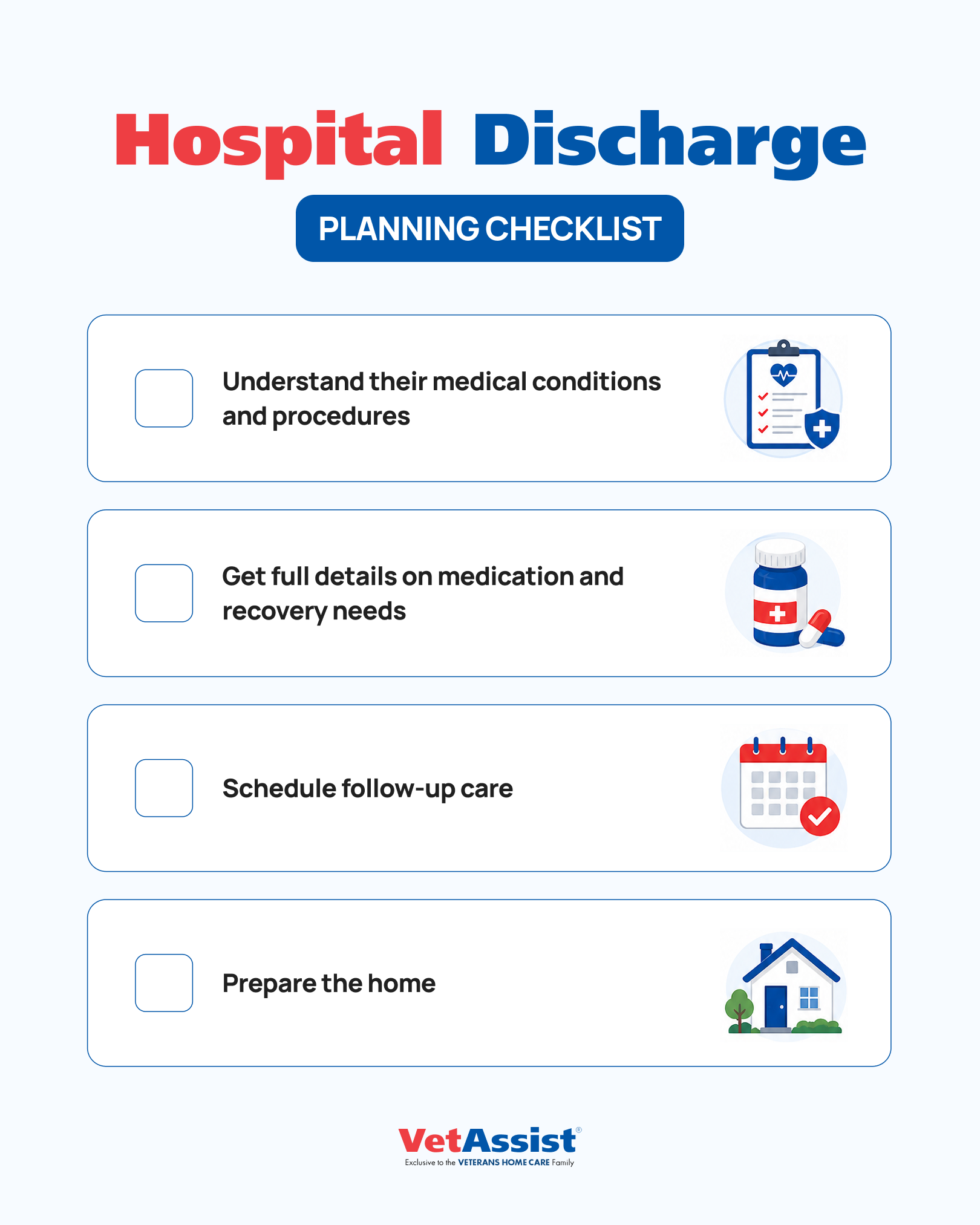
Make sure you have the following details for all upcoming follow-ups and related appointments:
- Dates/times
- Location
- Purpose
- Staff (i.e., will it be with their surgical staff, primary care doctor, someone else?)
- What to bring (here are some examples)
You may be asked to schedule your loved one’s rehabilitation-related appointments, such as physical therapy. Write down all referrals. Also start planning who will take your loved one to each appointment.
4. Prepare the home
The transition of care from hospital to home means taking stock of safety and comfort. Before you bring your loved one home, consider needed home modifications and make sure meals and prescription fills are planned-for. Consider the rooms where your loved one will sleep, bathe, and spend the day. Think about keeping water easily accessible and temperatures comfortable.
Note that a hospital is a highly structured environment, where everything runs on a schedule; as much as possible, try to create similar structure at home to minimize the chance of missing something important.
Brief Checklist Before Hospital Discharge
- I understand my loved one’s health conditions.
- I understand the care that was administered during their hospital stay.
- I know what warning signs to look for that signal we need to seek emergency care or readmission to the hospital.
- I have contact information for emergency and non-emergency purposes during recovery.
- I have a full list of medications they need to be taking, and the details of how/when.
- I know how and when to change wound dressing/work medical devices.
- I know what foods and activities they need to avoid during recovery, and what they need to do every day to support recovery.
- I know when, where, why, and with whom all their next appointments are scheduled.
- I know who is taking them to these appointments.
- I have prepared their/my home for them to transition safely and continue recovery.
- I know who to contact for additional support with home health or home care.
- I know who will be monitoring my loved one at all times during recovery.
Family caregivers work hard to support their elderly loved ones with disabilities and complex health conditions. Home care can be a life-changing resource, so our VetAssist mission is to make it easily and quickly accessible for those who qualify through the VA Pension with Aid and Attendance benefit. Veterans Home Care can help you determine whether you or your loved one will be eligible to receive the benefit, which can cover some or all of the cost of home care, and we make it easy to apply. Chat with us via our website, or call us at (888) 314-6075.

