
Facebook-f Twitter Youtube

Main Office Number: 1-877-390-6377

National Referral Number: 1-888-314-6075

Not sure which casino to choose?

OnlineCasinoLabs compares the top-rated online casinos available to Canadian players, covering everything from RTP rates to withdrawal speeds.

Referral Form
  • Aid & Attendance
    • Surviving Spouses
    • Veterans’ Stories
  • VetAssist®
    • Check Your Eligibility for the VetAssist Program
    • 0% Loan
    • Enhanced Care Plan Services
      • VetAssist Companion
    • FAQ
  • About
    • Leadership
    • Testimonials
    • News
    • Events
    • Press Release
  • Partners
    • Geriatric Social Workers & Case Managers
    • The Provider Opportunity
    • Testimonials from VetAssist Partners
    • Webinar Series
    • Regional Contacts
  • Blog
  • Careers
  • Contact
  • Referral Form
Menu
  • Aid & Attendance
    • Surviving Spouses
    • Veterans’ Stories
  • VetAssist®
    • Check Your Eligibility for the VetAssist Program
    • 0% Loan
    • Enhanced Care Plan Services
      • VetAssist Companion
    • FAQ
  • About
    • Leadership
    • Testimonials
    • News
    • Events
    • Press Release
  • Partners
    • Geriatric Social Workers & Case Managers
    • The Provider Opportunity
    • Testimonials from VetAssist Partners
    • Webinar Series
    • Regional Contacts
  • Blog
  • Careers
  • Contact
  • Referral Form
Home / Alzheimer’s Awareness Month 2023

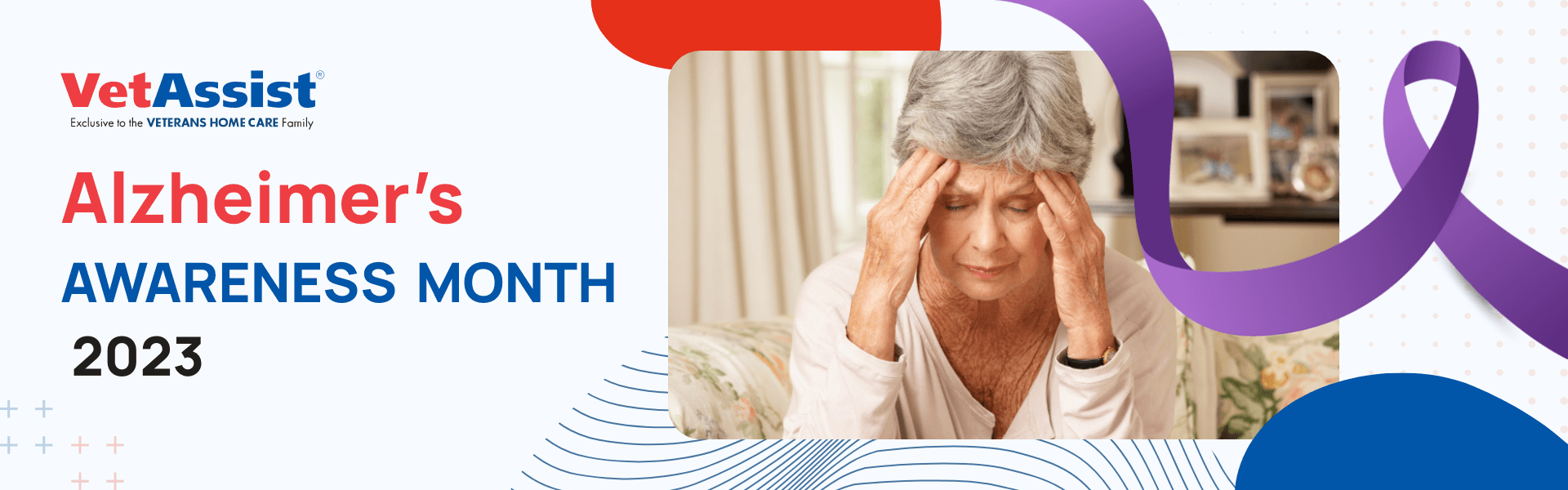
Alzheimer’s Awareness Month 2023

We’ll be performing system updates Wednesday evening, August 27st from 9:30 PM to 11:30 PM CT. The website may be temporarily unavailable at times during this period. We are sorry for any inconvenience.

Alzheimer’s Awareness Month 2023

November 1, 2023
Written by
Karolina Szot HungryMedia

Alzheimer’s Awareness Month 2023

Alzheimer’s Awareness Month is observed each year in November. The Alzheimer’s Foundation of America takes this annual opportunity to spur more dialogue and education around Alzheimer’s care and early signs of the disease.

There are currently over 6 million Americans living with Alzheimer’s Disease, and about 11 million spouses, children, grandchildren, siblings, and friends serve as their nonprofessional, unpaid caregivers. The Centers for Disease Control and Prevention estimate that most of these caregivers provide over four years of care to their loved one as their disease progresses.

Here, we cover signs of Alzheimer’s development and progression, tips for caring for someone with Alzheimer’s at home, and a few ways caregivers can find support.

Alzheimer’s Disease Signs and Progression

Though many elderly patients with dementia have Alzheimer’s, it is not the same as dementia. Dementia is an umbrella term for memory loss and cognitive decline severe enough to interfere with daily life. It can have many causes and can be a secondary symptom of another disease.

Alzheimer’s, on the other hand, is a specific neurodegenerative disease. It is progressive, meaning it gets worse over time. While the cause is unknown, the best theory proposes that a buildup of proteins in the brain causes irreversible brain damage; this happens many years before symptoms start to show. It currently has no cure.

Alzheimer’s Disease is more common in women than in men. Patients are most likely to be over the age of 65 (and especially over 75), but in some rare cases, symptoms begin much earlier. According to the Alzheimer’s Association, fewer than 1 in 5 Americans notice mild symptoms as they emerge.

There are generally three stages to Alzheimer’s Disease:

  • Mild: You may notice some memory loss, such as forgetting names and events and misplacing things more often, but the individual has no problems living daily life. They can still carry on conversations, plan ahead, and organize themselves, for the most part.
  • Moderate: Memory loss and confusion are more pronounced, and the individual might begin to express suspicion or repeat their questions. They may also start to wander and begin to have some problems completing tasks in daily life, as well as following instructions. They may also begin to show changes in mood and personality, becoming restless, frustrated, or depressed.
  • Severe/Late Stage: The individual needs help with most activities of daily living. They become unaware of their environment some or all of the time and can rarely or never carry on a conversation. They can have problems with eating (chewing and swallowing) and with incontinence.

Common symptoms of Alzheimer’s Disease include:

  • Memory loss (poor recall of names, events, known people, and how to do common or loved activities)
  • Repeating questions
  • Difficulty with language, including basic words like the names of common objects
  • Reduced initiative and spontaneity
  • Increased agitation or aggression
  • Losing things, especially in odd places
  • Poor judgment and decision-making, including with finances
  • Wandering and getting lost
  • Poor sleep and “sundowning,” where the patient becomes more restless and confused at night

Caring for Alzheimer’s Patients at Home

There are some guidelines that can improve outcomes for both the Alzheimer’s patient and their caregiver.

1. Communicate early.

If possible, have a conversation with your loved one early in their diagnosis to get an understanding of their wishes for their care and for end-of-life. This conversation will become increasingly difficult to have as their disease progresses. Include legal and financial matters that your loved one would want to settle while healthier.

2. Communicate with others.

Let others in your loved one’s life know—from other family members to bus drivers to housekeepers to mail carriers—that they are experiencing progressive symptoms of Alzheimer’s Disease. This helps them be vigilant, as well as understanding and supportive.

3. Communicate attentively.

When speaking to someone with dementia, face them fully and look them in the eye. Use their name often. Always speak with a calm voice, friendly expression, and relaxed body language. If appropriate, hold their hand.

Remember that losing the ability to communicate is deeply frustrating and isolating; speak to them often and offer the opportunity for them to communicate however they can. Also be sure to communicate as you carry out activities with and for them so they understand what you are doing.

4. Embrace routine.

Surprises and unpredictability can be especially distressing to someone with memory loss and cognitive decline. When caring for a parent with dementia at home, it is important to set up routines and rituals. This can also take some of the mental strain off the caregiver as regards daily planning. When changes are needed, make changes as gradually as possible.

Routine should also be applied to any medical care like daily medications or therapies, and can include fun activities such as puzzles and short walks.

5. Care for holistic health.

Whether cooking for them, shopping for them, or simply monitoring their wellbeing, ensure your loved one is eating nutritious foods at regular times. As chewing or eating itself becomes difficult for them, provide more accessible options like sandwiches cut in small pieces or nutritionally dense smoothies and soups.

Make sure they have time outdoors and regular walks. This can further offer mental stimulation and a sense of joy and calm. Simple activities like feeding ducks and visiting gardens can be beneficial to their mood.

In addition, incorporate routines like listening to music, painting, or playing any games they enjoy to keep their mind stimulated. Pay attention to candles, lotions, or other smells that they like (or dislike), as well as favorite blankets or clothing.

6. Safeguard the home.

Whether in-home Alzheimer’s care happens in their home or yours, be mindful of slipping and tripping hazards and home temperature. Consider safety locks on appliances like the oven, and take stock of how kitchen and bathroom cabinets are organized. Safety considerations for Alzheimer’s Disease can also include bright tape along hallways and doorways, lights in dark areas of the home, padding on sharp corners of furniture, a chair in the shower, and removing or limiting mirrors to prevent confusion when moving around. Additionally, voice-activated technology can help with quick emergency response and acting as a second pair of eyes and ears when you are not home.

Support for Caregivers

Loved ones often care full-time for their parents, spouses, and other relatives with Alzheimer’s because of a lack of resources like affordable professional care. This can cause huge strain on caregivers mentally, emotionally, physically, socially, and financially.

It is important for caregivers to find an outlet for respite care. Time to refresh and restore is essential and irreplaceable. Reject feelings of guilt and protect yourself from compassion fatigue by practicing self-compassion and self-care. Beyond asking friends and loved ones for help, investigate any untapped care resources if your loved one is an armed forces veteran, such as the VA’s Aid and Attendance benefit, which goes widely underused.

Caregivers should also bear in mind that dementia-related mood and personality changes can be difficult to understand and accept. Try not to take outbursts or unkind treatment personally. A support group—online or in person—can help you deal with emotional exhaustion and distress, as can one-on-one counseling with a licensed professional.

The Alzheimer’s Association predicts that about 13 million Americans will be diagnosed with Alzheimer’s Disease by 2050. These numbers represent even more caregivers who will need to learn how to help someone with dementia, even as they bear numerous other responsibilities. If your loved one needs home care, our VetAssist mission is to make home care easily and quickly accessible for those who qualify through the VA Pension with Aid and Attendance benefit. Veterans Home Care can help you determine whether you or your loved one will be eligible to receive the benefit, which can cover some or all of the cost of home care, and we make it easy to apply. Chat with us via our website, or call us at (888) 314-6075.

By Sylvia Trein, staff writer

Contact Us

National Headquarters:

11975 Westline Industrial Drive, St. Louis, Missouri 63146

Phone Number: 877-390-6377

Free Consultation and Referrals:

1-888-314-6075

Fax Referrals:

1-800-640-7988

Follow Us

CHECK YOUR ELIGIBILITY
Free service for yourself and or loved one

  • This field is for validation purposes and should be left unchanged.

Or Call 1-888-314-6075

The VetAssist® Program is offered exclusively by the Veterans Home Care® family of companies.

Veterans Home Care® and the VetAssist® Program are not part of any government agency and are not affiliated with the Department of Veterans Affairs (VA).

National Association for Home Care and Hospice member logo
Independent Home Care Alliance logo
Home Care Association of America logo
National Aging in Place Council member logo

Aid & Attendance

Surviving Spouses

VetAssist® Program

GovAssist

FAQ

Partners

Privacy

Contact

News

Careers

FOLLOW US

Facebook-f Twitter Youtube Linkedin-in
BBB Accredited Business Award Logo

Veterans Home Care, LLC | Veterans Home Care of California, LLC | Veterans Home Care NYJ, LLC | Veterans Home Care of Texas, LLC | VetAssist, LLC | VetAssist Atlantic, LLC | VetAssist Central, LLC | VetAssist Nevada, LLC | VetAssist Pacific, LLC | VetAssist West, LLC

Check Your Eligibility

Check Your Eligibility

  • This field is for validation purposes and should be left unchanged.
  • Aid & Attendance
    • Surviving Spouses
    • Veterans’ Stories
  • VetAssist®
    • Check Your Eligibility for the VetAssist Program
    • 0% Loan
    • Enhanced Care Plan Services
      • VetAssist Companion
    • FAQ
  • About
    • Leadership
    • Testimonials
    • News
    • Events
    • Press Release
  • Partners
    • Geriatric Social Workers & Case Managers
    • The Provider Opportunity
    • Testimonials from VetAssist Partners
    • Webinar Series
    • Regional Contacts
  • Blog
  • Careers
  • Contact
  • Referral Form

Saul Avila, SetxHomeCare

“VetAssist is a great service. There are benefits and services available that veterans don’t know about. Nurses and social workers dont’t know about them either, so it’s great to educate the community. The veterans can get services at home, and that’s where they want to be: in their homes.

How long have you been working with VetAssist

“7 years”

What’s your experience working with VetAssist?

“I started with the local Regional Manager. He was a huge help getting this going – the process of helping patients get their documents together, everything they need to get approval. “

What do you thing about the service?

“It’s great! It’s really needed in the community, because if the veterans were to apply for the benefits on their own, they are looking at a year process. We can start services usually within 30-45 days of everything being submitted. They’re able to stay in their own homes longer and get the help they need. “

What has been your experience helping veterans?

“It’s been a honor. They do not want to ask for anything. They want to do it on their own. When we reach out and tell them what’s available, they are very greatful. It means that a lot to me to be able to get it started for them, to make it easier on them. It’s a lot of paperwork.”

Cindy Stamps, AccentCare in Waco, Texas
with VHC Regional Manager, Nicole Figureo

“I’m a daughter, aunt, niece, and cousin of veteran, I did my research among companies similar services before I started working with VetAssist. I have exclusively worked with VetAssist for my veteras for three years.”

How long have you been working with VetAssist

“Exclusively for 3 years; did her research among companies with similar services”

What’s your experience working with Nicole?

“3 years. Also has a private pay; was doing her referrals, got a call from a girl with a strong NY accent looking for Marlena.”

What do you thing about the service?

“I love it because it’s easy to get in contact. They do what they say they’re gonna do. If there’s a mistake or miscommunication, they own up to whatever the problem is and do whatever they can to get it fixed. I have a Robin’s personal cell, David’s personal cel… They take the time to talk to me. I’ve been having problems with portal. It’s nice to know that if I have a question I will get it answered right away.I’m not patient when it comes to my veterans. “

What has been your experience helping veterans?

“It’s amazing. The VA do the veterans justice, and they are even less accomodating to the spouses. To know that I am able to help somebody to get the benefit and the care that they need to stay in their home is satisfying. I had to talk to a veteran the other day about his wife, and they do not qualify for the benefits because he’s already 100 % disabled. It breaks my heart because here are these men and women who served our country, and I can’t help them.”

“In central TX, we have a couple other agencies – I do not know how they are getting away with it – they are charging veterans $1200-1500 up front without a quarantee that they can get them benefits. The veterans reach out to me later and many tell me they do not qualify, and I say, how do you know you do not qualify?” I am often able to help them trough my VetAssist contact”

“I’m so thankful for Bonnie starting this company. I am very particular with my veterans, and I am gratefull that you guys are around, because you help me help my veterans.”

[video_lightbox_youtube video_id=”naT6xkMIvCs” width=”640″ height=”480″ anchor=”click here to open YouTube video” auto_thumb=”1″]

Robin Borders

Vice President, Sales

With more than a decade of senior care experience, Robin Borders is a respected leader in the home care industry.

Robin started at Veterans Home Care in 2012 in the Client Services Department, then joined the marketing team as a regional manager and was promoted to territory vice president. As a client service specialist, Robin monitored the home care of clients assuring they were getting the services they needed from a home care aide they trusted. Working as a regional manager, Robin made home visits to veterans and their families explaining the VetAssist Program.

Robin is instrumental in marketing our unique business model, educating the public on how we help people apply for a VA pension with Aid and Attendance and provide home care services. As a territory manager, Robin works with home care agencies and senior organizations across the country.

Prior to working at Veterans Home Care, Robin owned her own business as a manufacturer’s representative of restaurant equipment managing four states. Robin, a daughter of a Marine Korean War veteran and granddaughter of a Navy WWII veteran, grew up in St. Louis, Missouri and graduated with an associate degree from Florissant Valley Community College. Robin volunteers for the Alzheimer’s Association and is a member of the St. Louis Home Care Alliance.

Robin is a sought-after speaker and presenter based at our St. Louis, Missouri headquarters and oversees regional managers and company growth in 48 states

Howard Laiderman

Chairman

Howard began his career in his family’s automotive tire and auto parts wholesale and retail business which at one time was ranked 8th largest US tire dealer by Crane Publishing. He developed his skills in operations and executed marketing programs that resulted in sales from Fortune 500 companies including Walmart.

After the passing of Howard’s father, he ventured out on his own and started Ness Trading Company. With the help of his wife Bonnie and their two daughters, his new family operation quickly grew to one of the largest closeout and surplus specialists in the automotive parts and custom wheels industry.

Since 2003, Howard has worked with Bonnie growing Veterans Home Care to become the largest company of its kind offering in-home care to our deserving veterans through the unique VetAssist Program. Howard has been an integral part of the organization’s effort to brand the VetAssist Program and scale the business through provider contracting and client relationship management (CRM) technology.

Today Veterans Home Care has multiple locations throughout the country, and serves veterans in 48 states with a network of more than 4,000 home care providers. Veterans Home Care has also earned the Better Business Bureau’s Torch Award for Ethics and the Inc. 5000 Award of Fastest Growing Companies seven times.

Howard supports national veterans’ organizations and travels to Capitol Hill advocating for veterans and educating policymakers about the needs of veterans.

Bonnie Laiderman

Founder and Chairwoman Emeritus

As the founder and owner of Veterans Home Care®, Bonnie Laiderman has helped more than 20,000 veterans and their spouses receive in-home care through the unique VetAssist® Program.

Bonnie started the business in 2003 to answer a need in the military veteran community. Many veterans and their families don’t utilize available benefits from the Department of Veterans Affairs (VA) due to a lack of awareness. As a caregiver for her late mother, Bonnie personally experienced the frustration of failing to access available VA benefits in her mother’s time of need.

Bonnie has overseen the growth of the company from a one-woman operation to become one of the largest women-owned companies in the St. Louis Metro Region with multiple locations throughout the country, serving veterans in 48 states with a network of more than 4,000 home care providers.

Veterans Home Care has also earned the Better Business Bureau’s Torch Award for Ethics and the Inc. 5000 Award of Fastest Growing Companies seven times.

Bonnie personally has been recognized with numerous awards including the:

  • KTVI-Fox2 News Most Remarkable Women
  • McKnight’s News Publications’ Hall of Honor
  • Missouri Athletic Club’s Women of Distinction
  • St. Louis Business Journal’s Most Influential Women
  • Ingrams Magazine’s 50 People You Should Know and
  • Missouri Council for In-Home Service’s

In addition to growing Veterans Home Care to become the largest provider of its kind in the industry, Bonnie has been a strong supporter of numerous charitable and social organizations with both a local and national impact. Wings of Hope and Lydia’s House have both benefited from Bonnie’s support to continue services to our most vulnerable in need. Bonnie also is active in the American Red Cross as: a Tiffany Circle member, (a national society of women leaders), a chairperson for the Service Armed Forces Committee and a mentor in the Society of Women Leaders.

Carmen Perry-Tevaga

Vice President, Strategic Partnerships

As Vice President of National Accounts, Carmen develops and supports a nationwide network of home care and other senior care providers for Veterans Home Care’s brands. Carmen is responsible for these valued stakeholder relationships, identifying sales opportunities and developing comprehensive growth strategies for all parties involved.

Carmen’s 20+ years of healthcare administration experience spans multiple levels of care from physician practices to renown hospitals and rehabilitation services.

Having an extensive consulting background and subject matter expertise in VA Aid and Attendance benefits for older adult care, she’s a well-received speaker, podcast guest and presenter.

Carmen serves on the Home Care Association of America’s (HCAOA) Veterans Affairs Committee and serves as a board member for the National Aging In Place Council, (NAIPC) with whom she co-wrote a book on senior care.

Donna Appel

Vice President, Marketing

In her role as Vice President, Marketing, Donna oversees VHC’s marketing outreach and branding. Donna has more than 35 years of experience in sales, sales training and marketing.

Her wealth of business expertise includes a focus on the needs of older adults, caregivers and family members in need of home care solutions. She’s a resource to veterans’ organizations and senior care providers across the country and champions the mission to assist veterans, their spouses and their families with resources for them to age in place.

Those resources include the VetAssist® Program, which helps deserving veterans stay at home, if it is their choice, by obtaining home care with no out of pocket cost. As a daughter (and daughter-in-law) of a WWII veteran and a Veterans Home Care client, Donna is proud to serve these heroes and their families.

Donna is a member of the Veterans Council of Broward County and is currently on the Advisory Council for the Aging and Disability Resource Center of Broward County. Ms. Appel also mentors at risk teenagers through Take Stock in Children, an organization that funds college scholarships for at risk youth. Donna is part of a team for the Stepp’n Up Shoe Project that collects new shoes for Broward County children and distributes them to The Children’s Home Society, Child Net, Kids in Distress, The Anne Stork Center and several other organizations.

Marcy Seeney

Senior Vice President of VetAssist

Marcy Seeney, a dedicated advocate for senior care, has been an integral part of Veterans Home Care since January 2006. With a wealth of experience in the industry, Marcy was among the pioneering team members who joined her family on the company’s mission to support Veterans and Surviving Spouses in accessing essential care while maintaining their independence and dignity at home.

Over her remarkable 17-year journey, they have positively impacted over 22,000 families by facilitating their eligibility for the Aid & Attendance pension. Marcy is passionate about serving others and ensuring their well-being. Marcy continues to make a difference through her unwavering commitment to excellence in senior care. Networking in this space, she led the way for St. Louis and helped teach and train those who have gone on in the community to careers in home care.

Evan Kaltman

Chief Revenue Officer

Since opening the local Veterans Home Care NYJ office in 2009, Evan has overseen the expansion of the operations to include all of New Jersey as well as Pennsylvania, New York and Delaware. Evan is based at our Cedar Knolls, New Jersey office and leads sales operations nationwide.

Evan is a member of the New Jersey Association of Veterans Service Officers (NJAVSO). In addition, he serves as a board member for Welcome Home Vets of NJ.

Evan is a sought-after public speaker and strongly believes in educating social workers about the funding options available for our veterans and surviving spouses to receive in-home care. He is certified by the National Association of Social Workers – New Jersey Chapter (NASW-NJ) to provide training and issue “VA Benefits for Long Term Care” continuing education credits (CEU’s).

Heidi Friedman

General Council

Heidi is a distinguished VA accredited attorney and one of a few Florida Board Certified Elder Law Attorneys. With an unwavering commitment to honoring veterans and their families, Heidi has dedicated her career to providing expert legal assistance to veterans and their surviving spouses in obtaining VA Aid and Attendance benefits to assist with paying for the extraordinary cost of long-term care. Throughout her legal career, Heidi has amassed a wealth of experience in navigating the intricate landscape of VA benefits. Her expertise extends to advocating for veterans and surviving spouses, ensuring they receive the support they rightfully deserve.

Beyond her legal expertise, Heidi shares deep personal connections with the military community. As the proud sister of two army veterans and an aunt to a nephew currently serving in the armed services, her dedication goes far beyond professional duties. This unique perspective drives her passion for supporting those who have selflessly served our nation.

Heidi’s in-depth understanding of Elder Law and VA regulations has empowered numerous veterans to access essential benefits and resources. She possesses a rare ability to simplify complex legal processes, making it accessible for veterans and their families to navigate their journey smoothly. While her professional achievements are impressive, Heidi is not defined solely by her legal endeavors. She is the proud mother of two sons, one of whom has special needs, enriching her perspective and reinforcing her commitment to helping families navigate challenges with empathy and understanding.